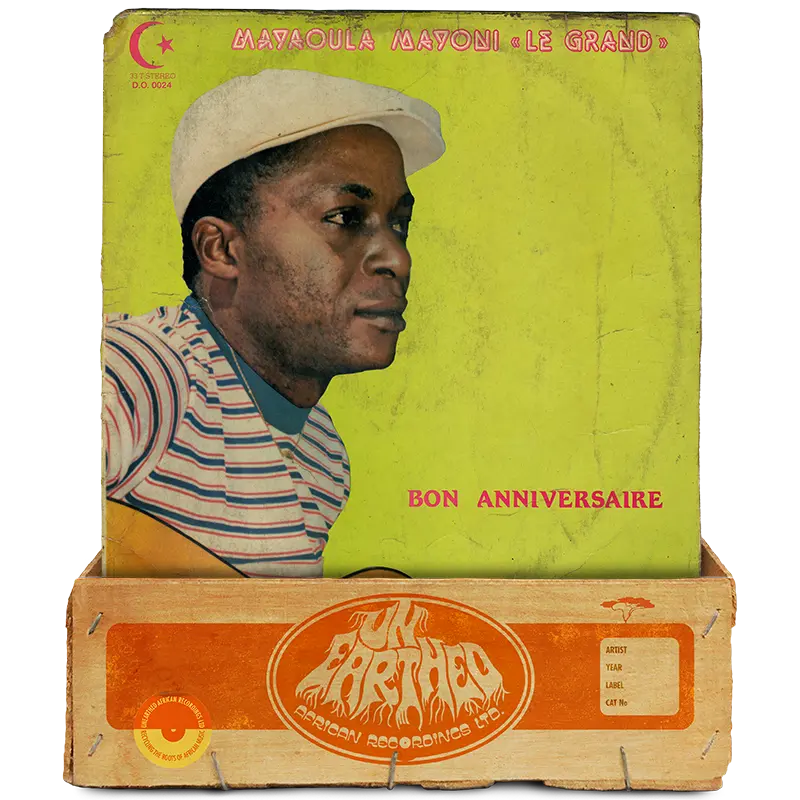
As one of Congo’s most versatile talents, Freddy Mayaula Mayoni (1946–2010) had a lasting impression on the country’s rich musical legacy and sports world. Mayoni, who was born in Léopoldville (now Kinshasa) on November 6, 1946, embodies the cultural vibrancy of post-colonial Zaire through his journey from football grounds to recording studios, leaving a legacy that permeates Central Africa’s music scene.
Mayaula was a gifted student who started what would apparently be a bright football career after graduating from the esteemed Collège de Kisantu in 1962. He made a name for himself as a talented left winger at AS Vita Club, one of Kinshasa’s most illustrious football clubs, from 1968 until 1971. His athletic ability led to his selection for Zaire’s national team, allowing him to display his skills on a global scale.
When his father’s diplomatic duties transported the family to Tanzania, Mayaula’s life took a global turn, and he played for the famous Yanga Sports Club for a short while. His football career continued in Europe when he moved to Belgium to play for Racing Club de Charleroi and Racing Club de Jette in Brussels while also studying computer technology. He also played football with FC Fribourg in Switzerland for a while, showcasing his versatility in a variety of athletic settings.
Mayaula found his music while he was living in Belgium. He joined the Congolese student orchestra Africana as a rhythm guitarist after learning the instrument from a friend, acquiring the talents that would eventually characterise his musical career. He made the crucial choice to give up football and pursue music full-time after returning to Kinshasa, which paved the way for his most significant contributions to Congolese culture.
The renowned Franco Luambo Makiadi, the leader of the renowned TPOK Jazz, acknowledged Mayaula’s songwriting ability and added his tune “Chérie Bondowe” to the band’s repertoire, which marked his debut. The Zaire National Censorship Commission banned the song from public broadcasts because of its contentious lyrics, which were seen as praising prostitution. However, after being first published in Brussels, the music found a listener before returning to Kinshasa, where it became popular underground.
Mayaula remained independent instead of officially joining TPOK Jazz, in contrast to many musicians who came into Franco’s sphere of influence. Rather, he made a name for himself as a prolific songwriter, contributing songs to a wide range of Congolese musicians. His discography encompasses a number of noteworthy pieces from multiple decades, such as the contentious but well-liked “Chérie Bondowe” (1975–1976), “Naya” (1977), sung by Mpongo Love; the poignant “Nabali Misère” (1979); his solo album “Fiona Fiona” (1986), which was released following his return from Togo; “Nasi Nabali” (1986), which became one of Tshala Muana’s signature hits; “Mizélé” (1989), which featured collaborations with TPOK Jazz musicians; “L’Amour au Kilo” (1993), which peaked Zairean charts; and “Bikini” (2000), his last album before health issues surfaced.
In Zaire, Mayaula’s composing genius won him the coveted “Composer of the Year” award several times (in 1978 for “Bondowe II,” in 1979 for “Nabali Misère,” and in 1993 for “Ousmane Bakayoko”), solidifying his standing as one of the country’s most gifted musicians.
Mayaula moved to Dar es Salaam, Tanzania, where he worked in diplomatic service after releasing “Bikini” in 2000. Sadly, hemiplegia, a disorder that results in partial paralysis and speech difficulty, marred his final years with health issues. After returning to Matadi, Congo, in 2005, his health continued to worsen, ultimately requiring medical care in Brussels, Belgium. Freddy Mayaula Mayoni died on May 26, 2010, at the age of 64, following months of sickness.
Despite his passing, Mayaula’s influence on Congolese rumba and soukous has left a lasting musical legacy. His lyrical and melodic genius is demonstrated by the fact that his songs, which are renowned for their lively rhythms and poetic narrative, still have an impact on modern African musicians. His incredible journey from football stadiums to concert halls is a testament to the creative adaptability and cultural versatility that many of Africa’s most significant musicians exhibited during this pivotal time in the continent’s history.