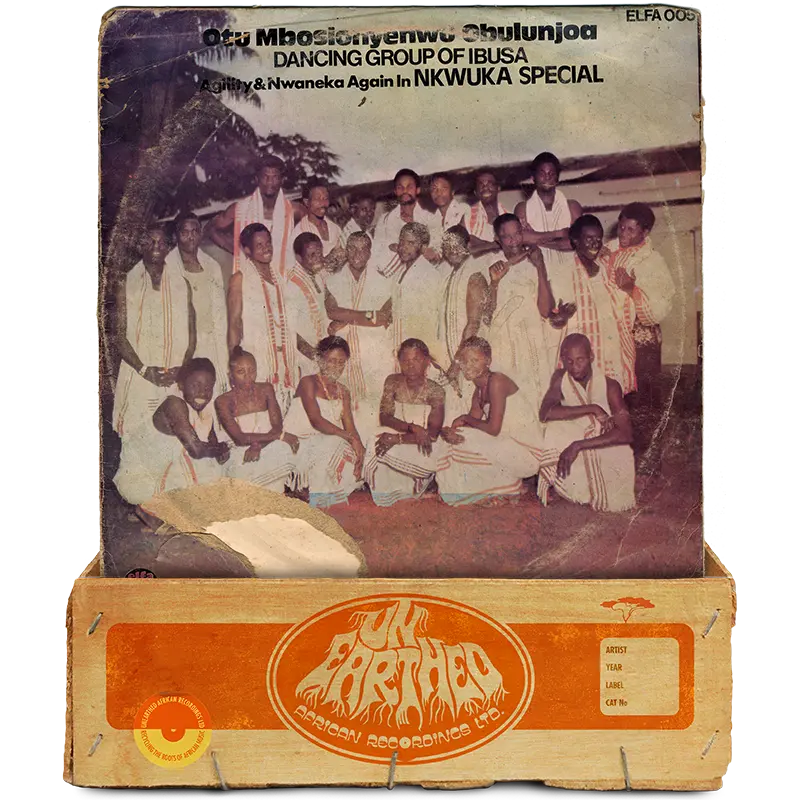
The Otu Mbosionyenwu Obulunjoa Dancing Group of Ibusa was one of the most influential cultural ensembles to emerge from the Anioma community during the 1980s. More than just a musical outfit, the group evolved into a social movement that brought together nearly 100 members, all united by the mission to preserve Anioma heritage and amplify the community’s political and cultural identity.
The group’s name, Mbosionyenwu Obulunjoa — meaning “the day one dies, he departs with his sins” — carried a profound moral and spiritual message. It represented both individual responsibility and collective accountability, making the group not only entertainers but also conveyors of ethical and social values within Anioma culture.
Formed during a period of cultural reawakening, the group quickly became the most organized and influential ensemble of its time. Membership extended beyond Ibusa natives, welcoming those who embraced their philosophy of togetherness through music.
Their leadership reflected Anioma’s traditional governance principles while adopting modern organizational discipline._x000B_ At the helm was Dana Okonji, popularly known as “Agility,” whose voice led the ensemble. He was supported by Nosike Ogbolu (“Mada”), the second lead singer, and Sunday Okolie (“Otangwolo”), whose third lead vocals were marked by witty aphorisms on social life. Instrumentalists added richness: Ikedinma Nwajine commanded the big gong (Uboma), while smaller pots and percussion instruments were handled by others. Maracas were played by Andrew Okafor, Sunday Okpobu, Emeka Agidi, Onuora Okocha (“Degeeg”), and Ekpe, with horns led by “Prof” Nwadishi — producing a layered, traditional sound.
Support extended beyond music. Senator Nosike Ikpo provided political patronage, while Queen Ebedike (Queen Ebubedike), born in Ibusa’s Umuafene quarter, offered cultural leadership, rehearsal space, and unwavering encouragement that earned her the title “the light that shone on Anioma.”
Through Elfrida Records in Lagos, and under producer Eze Obata with engineer A.M. Ikebuaku, the group created professional recordings that retained their live energy. Their albums, with design work by Kasi Azike and printing by Ibukunola Printers Ltd, reflected a commitment to quality. Releases like Nkwuka Special, Idaibo, Ogo Dinma, Iweanya, Olizele, and Otukpokpolokpo showcased the breadth of Anioma expression, from festive dance music to pointed social commentary.
The group’s influence went beyond music. They became advocates for Anioma State creation, using their songs to spread political awareness while reinforcing cultural solidarity. Dana Okonji earned recognition as one of Ibusa’s three greatest traditional musicians, alongside Ogbogu Okonji and John Nwanze Nwabuwa (Agbodi).
Although their career was short-lived, largely due to inadequate funding, their impact was enduring. Their music continues to resonate in Anioma consciousness, proving that a traditional music group could serve simultaneously as cultural preservers, educators, and political voices.