


Le Retour Des Évadés De Ponton La Belle - Jeannot Où Est Le Sérieux?
Lolo Lolitta, Tchico
Lolo Lolitta, whose work spans more than three decades across several artistic disciplines and continents, was born Lolita Babindamana in Congo-Brazzaville. At the age of four, Lolitta began dancing, marking the beginning of his artistic path. He established his qualifications in traditional African dance forms at the highest national level by becoming a dancer-choreographer with the renowned National Ballet of Congo-Brazzaville as a result of his extraordinary talent.
Lolitta’s early career was marked by a great deal of travel; he lived briefly in Ivory Coast and Nigeria and recorded music in several Central African nations. He was exposed to a variety of musical traditions and influences throughout this period, which would subsequently shape his artistic development.
Lolitta concentrated mostly on his musical career in the late 1970s and early 1980s, developing a close collaboration with Pambou Tchicaya Tchico. They collaborated to make a number of albums that had an influence on the music landscape of Central Africa. Among the noteworthy songs they produced together was “Jeannot, where is the seriousness,” which gained a lot of popularity.
A new chapter in Lolitta’s artistic career began when he moved to Paris, France, around 1983. He mainly concentrated on teaching African dance in Paris, where he shared his knowledge and cultural background with audiences throughout Europe.
In 1996, Lolitta formed the Ballet Theatre Lokolé dance company, which successfully travelled throughout France and many African nations. His virtuosity extended beyond dancing to include singing, drumming, and mbira playing, making him a truly interdisciplinary artist. This adaptability resulted in appearances on radio and television across the Caribbean, the US, and Europe.
Throughout his career, Lolitta collaborated with various African music giants, including Soukouss Machine, Les Quatre Étoiles (4 Etoiles), and Kanda Bongo Man, confirming his place in the African music scene.
Today, Lolitta is a significant representative of Congolese cultural customs and African artistic expression to audiences around the world because of his enduring influence as a performer and educator.
Tchico Tchicaya
Born Denis Pambou Tchicaya, Tchico Tchicaya was a well-known musician from the Congo whose impactful career spanned several decades and various nations. He made a name for himself as a versatile musician who worked as a singer-songwriter, guitarist, and arranger.
Saxophonist Paul Ngombe (also known as “Pincky”) was Tchico’s instructor when he joined the Manta Lokoka orchestra in Pointe-Noire in 1969, marking the beginning of his musical career. Songs like “Theresa-Rina” and “Santa-Maguy,” which were renowned for their beautiful vocal harmonies, showed off his creative abilities even in these early days.
When he joined Les Bantous de la Capitale, the top orchestra in Congo at the time, his career took off. After a number of important musicians left the group, Tchico was enlisted by Congolese music icons Nino Malapet and Jean Serge Essous to be one of the lead vocalists. He wrote “Isabelle mwana ya Kin,” the song that made him more popular, during this time.
Tchico started the global adventure that would shape his career in 1976. He initially moved to Nigeria, where he became fully involved in Afrobeat music until 1979. Having released four albums, this Nigerian chapter was incredibly popular and gained the moniker “Golden Voice” or “The Nightingale of Pointe-Noire.” With an astounding 800,000 copies sold, his song “Mamy-Rosa” earned him his first gold record. Following this success, he achieved his second gold record with “From Congo to Nigeria” in 1977.
In 1981, Tchico relocated to Abidjan, Ivory Coast, despite his success in Nigeria. His third gold record, “L’heure a sonné Régina” (The Hour Has Struck, Regina), was recorded there. He joined the thriving music scene in Abidjan, hanging out with well-known performers like Ernesto Djédjé, François Lougah, Mory Kanté, and Salif Keita.
He and Mavoungou Lolo Lolitta developed a strong musical collaboration during this time. They collaborated to release “Jeannot, où est le sérieux?” in 1981. (Where is the Seriousness? Jeannot), which went on to become a timeless masterpiece. The song peaked at number one on West African radio and television charts and was chosen the best song of 1982.
In an attempt to expand his career internationally, Tchico moved to Paris in 1983 alongside guitarist Denis Loubassou. African Kings, Afro Festival, Ponton la Belle & Lolo Lolita, Les Evadés de Ponton la Belle, Les Officiers de la musique africaine, Kilimandjaro, and Soukouss Machine were among the musical groups he recorded with in France as they changed over time. The songs “Soukous machine,” “Cocktail tropical,” and “Ambiance à Paris” were popular in dance circuits.
Alongside contemporaries Kanda Bongo Man, Aurlus Mabélé, Pepe Kalle, and Diblo Dibala, Tchico had become one of the most prominent figures in the Soukous music scene by the 1990s. By skilfully fusing Cuban salsa, Caribbean influences, and Congolese rumba, he created his distinctive style.
Moving to Australia from 1999 to 2005 was the next step in Tchico’s global adventure. There, he and singer Passi-Jo formed the band Warako Musica. In 2001, the group featured bassist Conrad Henderson, drummer Robbie Avenaim, keyboardist Michael Havir, rhythm guitarist Jim Swanston, singers and dancers Leona Chisala and Patrice Lumumba, and percussionist Aho Lowani. When Warako Musica won the “Australia Best Live Music Awards” in 2000, they gained a lot of fame.
After coming back to France, Tchico took charge of “Maya-Maya Musica,” which began playing in smaller venues. His intention was to preserve Congolese music while honouring the Bantous people’s customs. He surrounded himself with gifted musicians from the new music scene with Maya-Maya Musica.
Among the many languages in which Tchico sang and composed were Lingala, Kikongo, French, English, Spanish, Sango, Swahili, Vili (his mother tongue), and Lari. He was a truly cosmopolitan musician. In addition to many other ancient forms, his repertoire with Maya-Maya Musica included Congolese rumba, zébola, wara, kiburikiri, kingoli, and ekongo, among other ancestral melodies and folk dances.
Maya-Maya Musica drew influence for his rumba songs from the three main currents that served as the basis for the reputation of this genre: Franco Luambo’s TP OK Jazz, Bantous de la capitale, and African-Jazz orchestras.
From his early collaborations with Manta Lokoka in 1970 until his latter career, Tchico Tchicaya’s vast discography chronicles his development as an artist and his investigation of several African musical traditions. In the history books of African pop music, his legacy as one of Congo’s most varied and globally successful performers is cemented.


Artist:
Lolo Lolitta, Tchico
Original Release Year:
1/01/1981
Genre(s):
Soukous
Subgenre(s):
World
Release Country:
DRC
Artist Country:
DRC
Language(s):
Lingala
Producer(s):
Tchico Tchicaya
Composer(s):
Tchico Tchicaya
Publisher(s):
Unearthed African Music Ltd
track listings
-
Jeannot
8:41
Please note that preview tracks are limited to 30 seconds. To listen to the album in full, click here
-
Zena-Maiga
8:56
Please note that preview tracks are limited to 30 seconds. To listen to the album in full, click here
-
Anta, N'écoute Pas Les On-Dit
8:33
Please note that preview tracks are limited to 30 seconds. To listen to the album in full, click here
-
Aminata Haiball
10:07
Please note that preview tracks are limited to 30 seconds. To listen to the album in full, click here



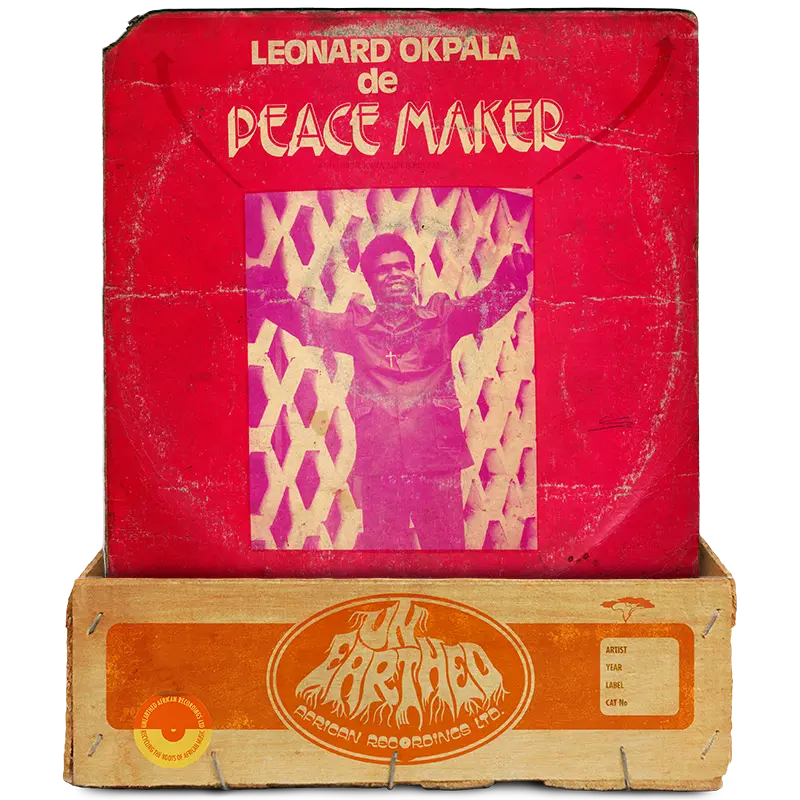
Dele Sosimi’s Pick Of The Month
Leonard Okpala De Peace Maker & His Ndichia Super Sound
is a this Juju gem, showcases the signature style of the mighty Apola King himself and consists of two continuous “takes” of several of his lesser known songs.